Virtual Reality in Education: Benefits, Use Cases & Why Every School Should Experience a VR Demo
Education is evolving faster than ever before. Today's students learn differently than previous generations, and schools are looking for innovative ways to make classrooms more engaging, interactive, and effective. One technology leading this transformation is Virtual Reality (VR). Instead of simply reading about a topic, students can experience it. They can explore the solar system, walk through ancient civilizations, understand the human body in 3D, or witness scientific phenomena—all within a safe and immersive virtual environment. This shift from passive learning to experiential learning is helping schools improve concept clarity, student engagement, and learning outcomes. In this guide, we'll explore what Virtual Reality in education is, its benefits, real-world classroom applications, and why every school should experience a VR demo before adopting immersive learning
 Sanjana Singh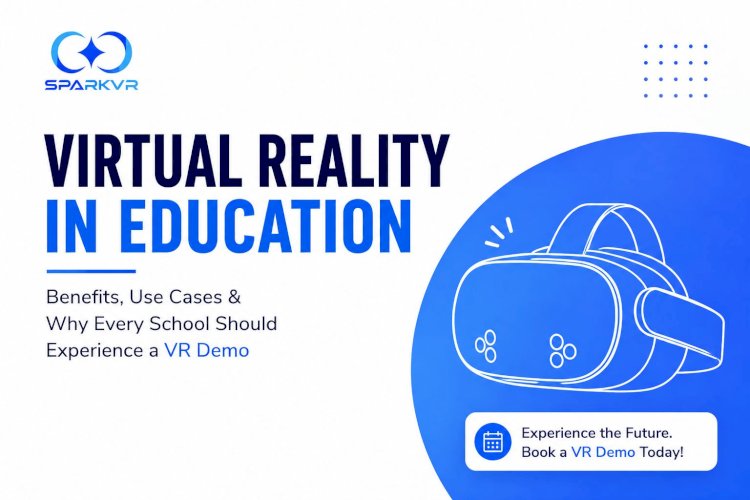
Virtual Reality is Transforming the Future of Education
Virtual Reality (VR) in education uses immersive technology to create interactive learning environments where students can explore concepts in three dimensions. Using VR headsets, learners can engage with educational content that feels real, making complex ideas easier to understand.
Unlike videos or animations, VR places students inside the lesson, allowing them to interact with the learning experience rather than simply observe it.
For schools, VR acts as a teaching enhancement tool that supports classroom instruction and helps students build a deeper understanding of academic concepts.
Why is Virtual Reality Becoming Important in Schools?
Traditional teaching methods remain valuable, but many subjects require students to imagine processes, places, or structures that cannot be easily demonstrated in a classroom.
Examples include:
-
The human circulatory system
-
The solar system
-
Volcanoes and earthquakes
-
Ancient civilizations
-
Molecular structures
-
Environmental ecosystems
Virtual Reality bridges this gap by allowing students to experience these concepts visually and interactively, improving both understanding and retention.
As schools embrace technology-enabled learning and the vision of NEP 2020, VR has become an effective way to deliver experiential education.
Top Benefits of Virtual Reality in Education
1. Improves Concept Clarity
Students often struggle with abstract concepts. VR helps them visualize topics in a realistic environment, making difficult lessons easier to understand.
2. Increases Student Engagement
Interactive experiences naturally capture students' attention. VR transforms classroom sessions into active learning experiences where students participate rather than simply listen.
3. Enhances Knowledge Retention
Research consistently shows that students remember experiences better than passive reading. Immersive learning helps improve long-term understanding of key concepts.
4. Supports Experiential Learning
Experiential learning encourages students to learn by doing. VR allows schools to provide experiences that would otherwise be expensive, dangerous, or impossible in a traditional classroom.
5. Makes Learning More Enjoyable
When learning is interactive, students become more curious and motivated. This creates a positive classroom environment that encourages exploration and creativity.
6. Helps Teachers Explain Complex Topics
VR doesn't replace teachers—it empowers them. Teachers can use immersive content to simplify difficult concepts and make lessons more impactful.
7. Creates Future-Ready Classrooms
Integrating VR demonstrates a school's commitment to innovation and prepares students with the skills and confidence needed in a technology-driven world.
Real Classroom Use Cases of Virtual Reality
Virtual Reality can be integrated across multiple subjects and grade levels.
Science
Students can observe chemical reactions, explore ecosystems, and understand scientific concepts through immersive visualizations.
Biology
VR enables learners to travel through the human body, study organs in 3D, and better understand anatomy and life sciences.
Geography
Students can visit mountains, oceans, deserts, forests, and world landmarks without leaving the classroom.
History
Historical events and ancient civilizations become more engaging when students can experience them virtually instead of reading about them in textbooks.
Astronomy
Students can explore planets, understand space, and visualize the solar system in an immersive environment.
STEM Education
VR encourages curiosity, problem-solving, and innovation by making science and technology concepts interactive.
How Virtual Reality Supports NEP 2020
The National Education Policy (NEP 2020) encourages schools to adopt innovative teaching methods that focus on experiential, competency-based, and technology-enabled learning.
Virtual Reality aligns with these goals by:
-
Promoting experiential learning
-
Improving conceptual understanding
-
Encouraging active student participation
-
Supporting digital education initiatives
-
Making classrooms more interactive
Schools implementing VR are taking an important step toward building future-ready learning environments.
Why Every School Should Experience a VR Demo
The best way to understand the impact of Virtual Reality is to experience it firsthand.
A live VR demo gives school leaders, teachers, and students the opportunity to see how immersive learning works in a real classroom environment.
During a SparkVR demo, schools can:
-
Experience curriculum-aligned VR lessons
-
Observe student engagement in real time
-
Explore subject-wise learning modules
-
Understand classroom implementation
-
Learn how VR integrates with existing teaching practices
This hands-on experience helps schools evaluate how immersive learning can enhance their academic programs before making a long-term decision.
Why Schools Choose SparkVR
SparkVR is designed specifically for schools, making it easy to introduce immersive learning without disrupting existing classroom routines.
Key advantages include:
-
Curriculum-aligned educational content
-
Teacher-guided learning sessions
-
Interactive and immersive VR experiences
-
Easy classroom implementation
-
Support for experiential learning under NEP 2020
-
Structured sessions that fit within regular school schedules
SparkVR enables schools to make learning more engaging while helping teachers explain complex topics with greater clarity.
Experience the Future of Learning with SparkVR
The future of education is not about replacing teachers or textbooks—it's about enhancing learning through meaningful experiences.
Virtual Reality helps students understand faster, remember longer, and stay engaged throughout the learning process. For teachers, it becomes a powerful instructional tool. For school leaders, it demonstrates a commitment to innovation and academic excellence.
If your school is exploring ways to improve classroom engagement and deliver future-ready education, a SparkVR VR demo is the ideal place to begin.
Experience immersive learning firsthand and discover how Virtual Reality can transform your classrooms into spaces where students don't just learn—they experience learning.