Beyond Books: Discover How VR Brings Every Lesson to Life
Discover how Virtual Reality is transforming classroom learning by making Science, Space, Human Anatomy, Geography, History, Mathematics, and STEM more interactive and engaging. Learn how SparkVR helps schools improve concept clarity through immersive, curriculum-aligned VR experiences.
 Sanjana Singh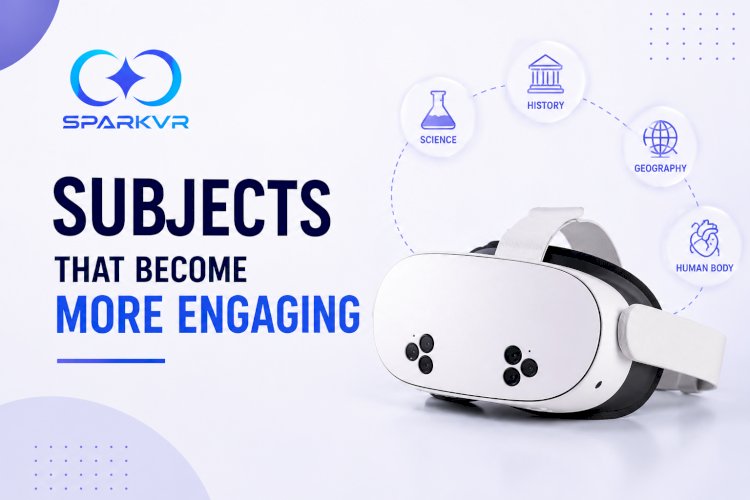
Subjects That Become More Engaging with VR
Today's students don't just want to read concepts—they want to experience them.
Traditional classrooms often rely on textbooks, diagrams, and lectures to explain complex topics. While these methods remain valuable, many concepts are difficult to visualize. Virtual Reality (VR) bridges this gap by allowing students to explore, interact, and learn through immersive experiences.
At SparkVR, learning goes beyond imagination. With curriculum-aligned immersive modules, students can explore scientific phenomena, travel through history, understand the human body, and even journey into space—all within the classroom. SparkVR
Let's explore the school subjects that become significantly more engaging with VR.
1. Science – Understanding Instead of Memorizing
Science is full of concepts that are invisible to the naked eye or impossible to recreate inside a classroom.
Instead of simply reading about atoms, forces, electricity, or chemical reactions, students can observe these concepts in immersive 3D environments.
SparkVR enables learners to interact with scientific models, making abstract topics easier to understand and remember.
2. Space – Explore the Universe Without Leaving the Classroom
Imagine students walking on Mars, observing planets up close, or understanding the solar system from inside a VR environment.
Instead of static diagrams, VR provides an unforgettable learning experience where students feel present inside space.
This improves curiosity, engagement, and long-term concept retention.
3. Human Body – Learn Anatomy in 3D
Human anatomy is one of the most challenging chapters for students because organs and body systems are difficult to visualize using textbook images.
With SparkVR, students can:
-
Explore the human heart
-
Observe body organs in 3D
-
Understand body systems
-
Learn biological processes interactively
Rather than memorizing diagrams, students experience how the body actually works.
4. Geography – Travel Across the Earth Virtually
Geography becomes exciting when students can visit places instead of simply reading about them.
Using immersive VR experiences, students can:
-
Explore volcanoes
-
Understand Earth's layers
-
Visit mountains and deserts
-
Learn about rivers and ecosystems
-
Observe geographical formations
Virtual field trips improve understanding while making every geography lesson memorable.
5. History – Step Inside the Past
History is no longer limited to timelines and paragraphs.
With VR, students can virtually experience:
-
Ancient civilizations
-
Historical monuments
-
Important battles
-
Cultural heritage
-
Significant historical events
Immersive storytelling creates emotional connections that help students remember historical events much better than traditional methods.
6. Mathematics – Visualize Every Concept
Many mathematical concepts become easier when students can actually see them.
VR helps learners understand:
-
Geometry
-
3D shapes
-
Angles
-
Measurements
-
Spatial reasoning
Interactive visualization builds stronger conceptual clarity while reducing the fear often associated with mathematics.
7. STEM Education – Learning by Doing
The future belongs to problem-solvers.
SparkVR combines Science, Technology, Engineering, and Mathematics into immersive experiences that encourage students to think critically, experiment confidently, and solve real-world challenges.
Instead of passive learning, students actively participate in educational experiences that prepare them for tomorrow's careers.
Why VR Makes Learning More Effective
Research and classroom implementations consistently show that immersive learning increases engagement because students participate instead of simply observing. Educational VR also improves concept visualization, supports experiential learning, and enhances long-term retention of difficult topics.
SparkVR has been designed specifically for schools with:
-
Curriculum-aligned modules
-
Teacher-guided sessions
-
Interactive 3D experiences
-
Structured classroom implementation
-
Continuous subject expansion
-
NCERT-aligned content
-
School-ready deployment
-
Assessment-supported learning
Why Schools Choose SparkVR
SparkVR isn't built as entertainment—it's built as academic infrastructure.
Schools benefit from:
-
Curriculum-aligned immersive learning
-
Easy classroom integration
-
Teacher training and support
-
Interactive subject-wise modules
-
Improved student engagement
-
Better concept clarity
Whether it's Science, Geography, Human Anatomy, Space, Mathematics, or History, SparkVR transforms lessons into experiences that students never forget.
Final Thoughts
Education is evolving beyond textbooks.
Students understand concepts faster when they can see, explore, and interact with them. Virtual Reality is making classrooms more engaging, meaningful, and future-ready.
With SparkVR, every lesson becomes an experience, every concept becomes visual, and every classroom becomes a place where curiosity comes alive.
Ready to transform learning in your school?