
From Idea to Impact: How Founders Can Track Growth Without Becoming Accountants
Learn how startup founders can track business growth, key metrics, and financial health without getting lost in accounting. Simple, practical insights for early-stage startups.
 Muskaan Harbhajanka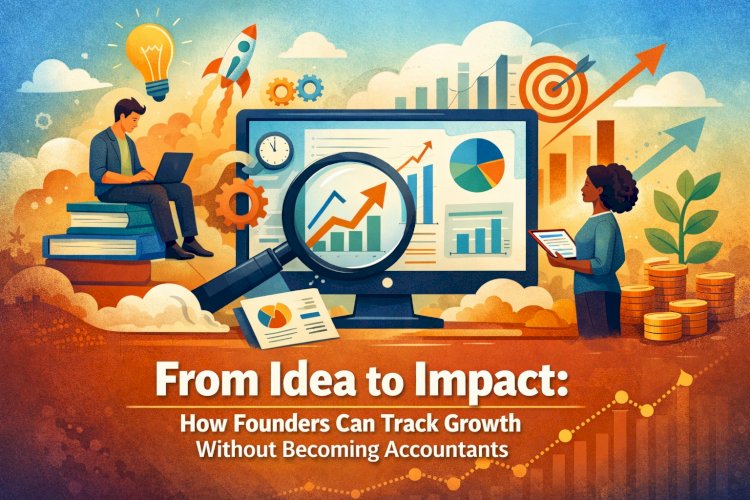
Every founder starts with an idea. A spark. A problem worth solving.
But somewhere between late-night brainstorming and real-world traction, a new challenge appears—tracking growth.
Suddenly, there are numbers everywhere: revenue, burn rate, CAC, runway. And before you know it, you’re knee-deep in spreadsheets wondering, “Did I sign up to build a company or become an accountant?”
Good news: you don’t need to be an accountant to track growth effectively. You just need clarity, consistency, and the right mindset.
Why Tracking Growth Matters (Even in the Early Days)
Growth tracking isn’t about impressing investors or preparing financial statements—it’s about making better decisions.
When founders track the right metrics:
- They know what’s working (and what’s not)
- They avoid cash flow surprises
- They can course-correct early
- They build credibility with stakeholders
In short: numbers don’t limit creativity—they protect it.
Focus on Signals, Not Noise
One of the biggest mistakes founders make is tracking everything. More data doesn’t mean more insight.
Instead, identify a few core signals that reflect your business health.
For example:
- Revenue growth – Is money coming in consistently?
- Customer traction – Are users returning or referring others?
- Costs vs returns – Are you spending wisely to grow?
- Runway – How long can you operate with current funds?
If a number doesn’t help you make a decision, it’s probably not worth tracking right now.
Keep It Simple (Seriously)
You don’t need complex accounting software on day one. Many founders start with:
- A basic spreadsheet
- Monthly tracking instead of daily
- Clear categories for income and expenses
Think of it like a business health dashboard, not a financial thesis.
If you can understand it at a glance, you’re doing it right.
Build a Habit, Not a System
Growth tracking works best when it’s routine, not reactive.
Set aside time—weekly or monthly—to review:
- What changed since last time?
- Why did it change?
- What decision should I take next?
Consistency beats complexity. A simple system reviewed regularly is far more powerful than a perfect one you never open.
Use Tools That Think With You
Today’s tools are designed for founders, not accountants. Many platforms:
- Auto-categorize expenses
- Generate simple reports
- Show trends visually
The goal is to spend less time calculating and more time understanding.
Know When to Ask for Help
At some point, getting expert input is a smart move—not a weakness.
An accountant or finance advisor can:
- Set up your structure
- Help with compliance
- Guide you during fundraising or scaling
But remember—the expert supports the founder.
You don’t need to become one.
Growth Is a Story—Numbers Just Tell It
Behind every metric is a story of customers, decisions, experiments, and learning.
Tracking growth isn’t about chasing perfection—it’s about staying aware.
Founders who understand their numbers don’t lose creativity.
They gain control, confidence, and clarity.
So build boldly. Track simply.
And let your idea grow into real impact—without turning into an accountant along the way.