
Cracking the Trust Code: The Art of Acquiring Your First 100 Customers in India
The "First 100" is not a sales metric; it is a product-market fit stress test. Unlike the US market, where early adopters often buy based on novelty, the Indian consumer buys based on trust. To bridge this gap, founders must move beyond standard growth hacking and embrace strategies rooted in the unique psychology of the Indian market.
 Satyam jat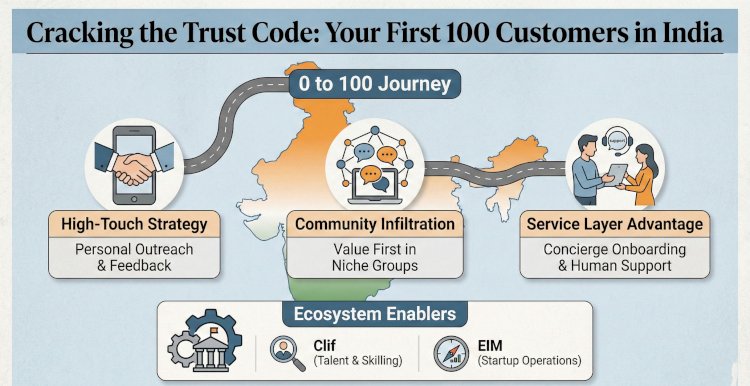
In the dictionary of the Indian startup ecosystem, the journey from zero to one hundred customers is often idealized as a sprint. In reality, it is a siege. India is a market of deep contradictions: massive in scale yet micro in its communities; value-conscious yet deeply loyal once trust is established. For a founder standing at zero, the challenge is not visibility—it is credibility.
The "First 100" is not a sales metric; it is a product-market fit stress test. Unlike the US market, where early adopters often buy based on novelty, the Indian consumer buys based on trust. To bridge this gap, founders must move beyond standard growth hacking and embrace strategies rooted in the unique psychology of the Indian market.
The Geography of Trust
The first mistake founders make is attempting to scale before they have validated. In India, trust radiates outward. Your first customers are rarely strangers who clicked on a Facebook ad; they are your "warm network."
Successful founders often employ a "high-touch" strategy for their first 100. This involves identifying potential users within personal and professional networks and engaging them not with a sales pitch, but with a request for counsel. In a culture that values relationships, asking for "advice" on a product is disarming. It turns a potential transaction into a collaboration. When a founder personally onboards a user, troubleshoots their issues via WhatsApp, and iterates based on their feedback, they aren't just acquiring a customer; they are deputizing an evangelist.
Community as the New Distribution
With Customer Acquisition Costs (CAC) rising globally, the Indian founder’s greatest asset is community infiltration. The digital landscape is fragmented into micro-communities—from LinkedIn threads discussing B2B pain points to regional Telegram groups and niche Facebook communities.
The strategy here is "Value First, Ask Later." Founders who succeed in this phase are those who contribute genuine expertise to these communities before asking for a signup. In a noise-filled digital economy, utility is the only currency that matters. By solving small problems for free in public forums, founders earn the right to offer their paid solution.
The "Service Layer" Advantage
Perhaps the most distinct feature of the Indian market is the expectation of service. Even purely digital products often require a "human layer" to succeed initially.
For the first 100 customers, scalability should be ignored. Founders must offer concierge onboarding—walking the customer through the setup, offering direct phone support, and manually handling processes that will later be automated. This "unscalable" work builds the structural integrity of the business. It reveals the friction points in the user journey that no analytics dashboard can show.
The Role of Institutional Support
While the founder’s hustle is central, the ecosystem surrounding them is evolving to reduce this friction. Enablers like Incubation Masters and IM Global are shifting the paradigm by offering continuous, structured intervention rather than passive advice. Through proprietary digital platforms like EIM which streamlines talent acquisition which acts as an operational compass for startups, they provide the essential infrastructure that allows founders to focus entirely on the relentless pursuit of those first 100 relationships.
The Verdict
The first 100 customers in India are the hardest to get because they are the most expensive—not in terms of money, but in terms of emotional labor and trust-building. However, once captured, they become the bedrock of a resilient brand. In India, you do not build a business and then find customers; you find 100 customers, serve them obsessively, and they build the business for you.